

I'll be honest with you all — this post is something I've sort of been putting off writing. But, with the HYROX Boston happening this weekend (along with how many people have asked me for my thoughts on this recent incident 🤢), I figured I would give my take on one of the fastest growing "sports" we've seen in a long time, and how one can/should approach it.
First, if you're unfamiliar with HYROX, it bills itself as "Fitness Racing," and combines running with "functional workout stations."
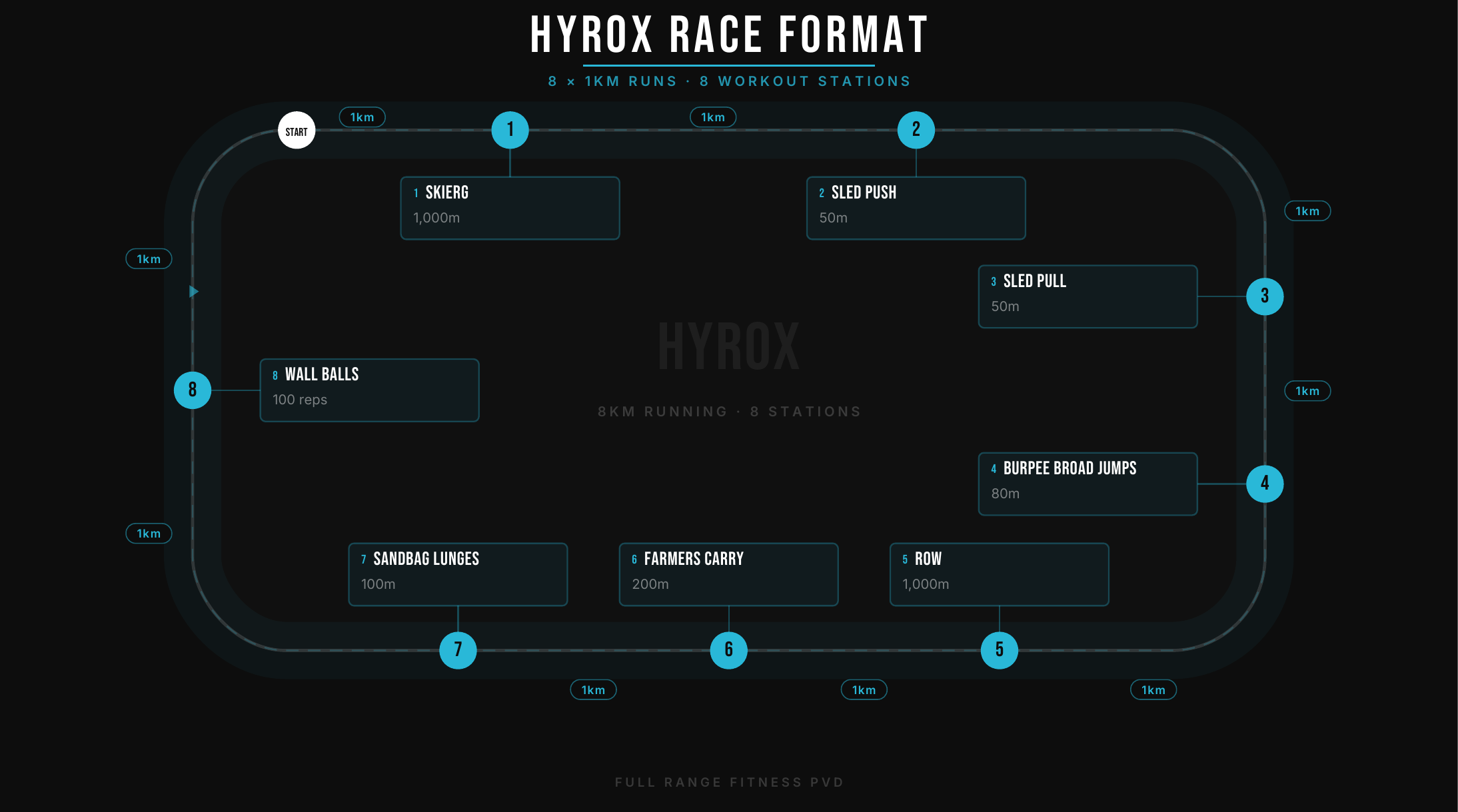
Hyrox Race Format
Now, before I get into my thoughts on how to effectively train for an event like this, let's first ask the important question:
Why Do HYROX?
The people that choose to do one (or many) HYROX races generally fall into a few buckets. The first of these is the small subset of folks that are competing for "HYROX WORLD CHAMPIONSHIP," and look to win money and/or acclaim. For the sake of this post, we are going to assume that this is not you (no offense).
The next reason, and one that I feel many can connect with, is the opportunity to push oneself in a workout that is legitimately challenging to complete. While it's probably not on par, pain-wise, with a triathlon or marathon, a 60+ minute effort that includes 7k of running is, for most people, a good chunk of work.
Similarly to this, having an event or challenge coming up can be a useful tool for keeping us engaged and motivated in our training. Much like putting a deadline on a project, having a HYROX looming on the horizon can help us to ensure that we are pushing ourselves to prepare the best we can, and give intention in our hard work.
Now the next reason (and this is probably the source of my reluctance in writing this piece), might not even be a conscious one for some that have it: that is, doing a HYROX to say you "did a HYROX."
The first time I went to one of these events, in Boston last year, it was impressive to see just how many people came out to race (I believe it was about 11,000 total over the 2 days). But the other thing that caught my eye was the length of the line of people waiting to take a picture in front of the screen holding their race time.
Of course, not all of these people were doing this race for vanity, and, of course, we should be proud of ourselves, and willing to share our accomplishments with others. My personal bias (and experience), though, makes me wary of an event that is just so built on aesthetics and social media exposure, especially when they charge a lot of money for people to get involved (Again, just my bias — though a coach who I like — who is a bit more cynical than I am — called HYROX "cosplaying being an athlete," and I do get a chuckle out of that).
How to Train for a HYROX
If you do decide to take on an event like this, it's best to be prepared.
First, if you train at our gym, and are interested in competing in HYROX (which we fully support, the last few paragraphs notwithstanding!), you are in luck: the skill-based aspects of the race — rowing, skiing, wall balls, lunges, farmer's carries — are all things that you train here regularly, often times under fatigue. So, the issue facing many traditional endurance athletes — that is, not having ample experience with these modalities, especially the weighted ones — is not an issue for you. Yay!
The truth is, though, that this is by and large still an endurance event. In fact, I'll go one step further and say that this is mostly a running event (though ONLY running for training won't fully prepare you), so if you've been avoiding putting in some mileage on the road/track, your regimen needs to be adjusted accordingly.
If we want to break down training for a HYROX into 3 areas (ignoring, for a moment, things like nutrition and recovery), we have:
Strength Training — resistance work with the goal of getting stronger, improving movement quality, and building functional range of motion. From what I've seen, this is what most casual HYROX (or other endurance sport) trainees tend to under-emphasize — or ignore altogether, unfortunately — which is a shame; having strong joints will not only help prevent injury in sport, but being stronger overall makes all weighted movement take less energy to complete.
Running Work — training specifically to get better at running. This can (and should) include both longer, steady-paced runs, as well as faster intervals to build speed. It should NOT be a ton of volume all at once, especially for someone that hasn't been running a lot.
Mixed-Modal Training — as mentioned above, movements like Wall Balls, Burpee Broad Jumps, and Farmer's Carries need to be completed efficiently, especially when under fatigue. In my experience, this can't be accomplished without some blending of these elements in circuits or intervals.
Here is a sample three-day training split, balancing all of these:
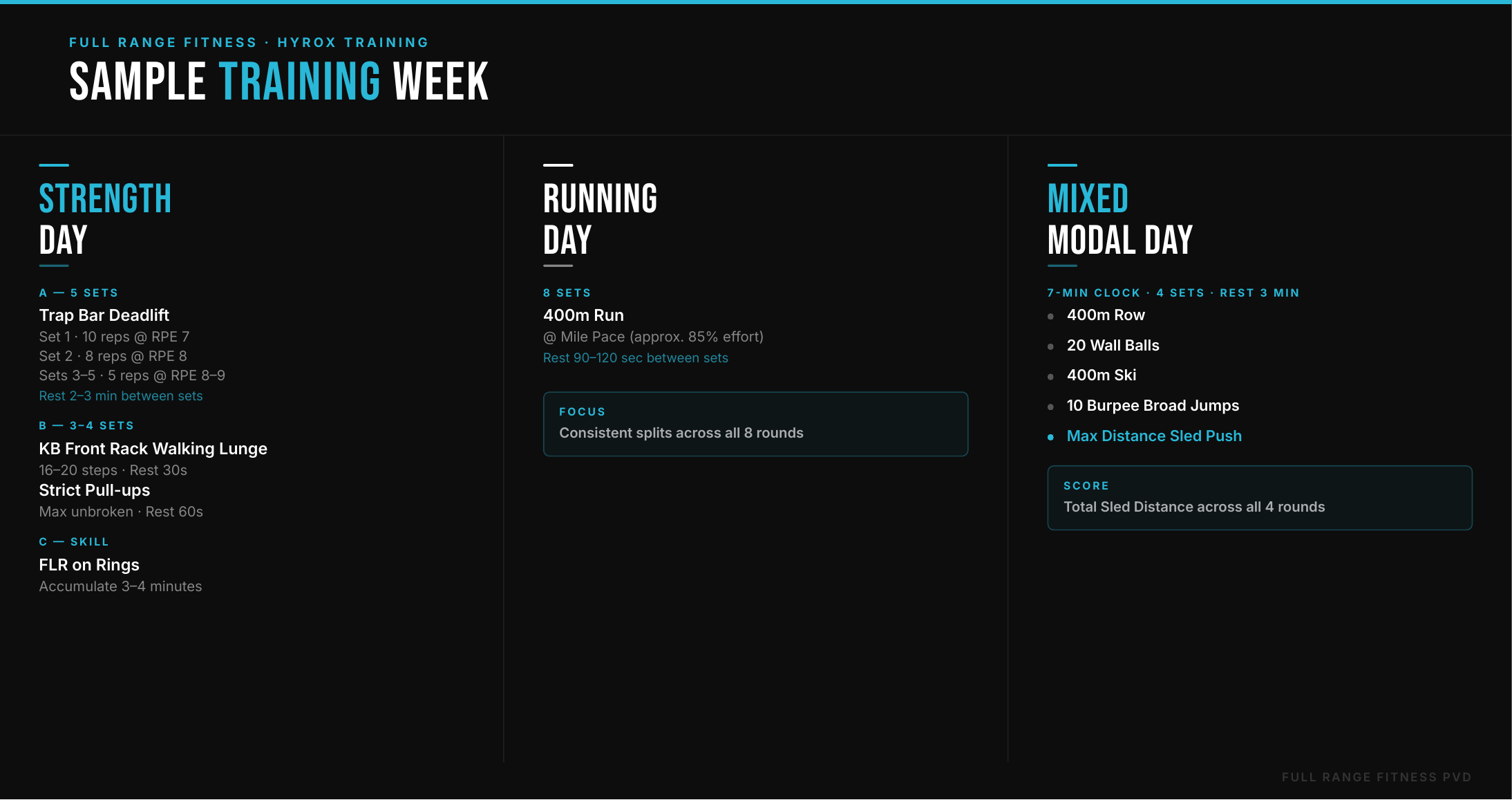
This pattern can be repeated after a rest day, or, the remainder of the week could be made up of whichever sessions YOU need most.
And that's the final piece of this: specificity. If I'm a marathoner, and I have three months to prepare for my first HYROX, my training probably shouldn't look the same as someone coming from, say, a Powerlifting background. Sport-specific training acknowledges that there is an end goal, or a standard set of capabilities shared by those that are successful in that arena. So, while having balance in our training is important for real life fitness, health, and longevity, getting ready for a competition is a completely different animal.
Which brings me back to the "why are we doing this" question, and my final thoughts on this:
I believe that the participation in any sport is only beneficial to us when we can recognize that said sport is a GAME, being played for FUN, and that points or times on a leaderboard are only as important as we make them out to be (note: the only times that this statement is not true are when the sport is being played for money, or for survival, or both). It is a worthwhile endeavor, in my opinion, to put effort into getting better at sports or games because they a) teach us things about ourselves and others that we might not learn otherwise, and b) provide an authentic sense of accomplishment both when we improve in them, and when we can raise the game of those around us.
Sport is not beneficial when it becomes our sense of identity, or when it's an avenue for us to make unnecessary comparisons with others. It's also lost its utility, to me, when we are sacrificing our long-term health, or short-changing our true potential, for anything that's not our actual career (or, perhaps, some kind of Hunger Games situation).
As for HYROX, while it's trendy, and might not last for the long haul, I don't think it's a bad thing to train for at all. In fact, I'm glad that it's moved some people away from CrossFit competitions — the training for which is simply too demanding for most — and into a more sustainable domain. Plus, if you can get the endurance crowd to start doing some heavy Farmer's Carries, that's an overall win in my book.
So, like most things, do it if you're into it, as long as it doesn't hurt anyone else (or yourself, too permanently). Set a goal for yourself, and do the preparation necessary to put yourself in the position to achieve it. And, above all, enjoy it, because it's just a game, and, in reality, it's all for YOU, and no one else.
To those racing this weekend: good luck, have fun, and try not to poop yourselves! (Sorry, couldn't help it)